
Placement Experience at Cairnmillar Institute — A Student Guide
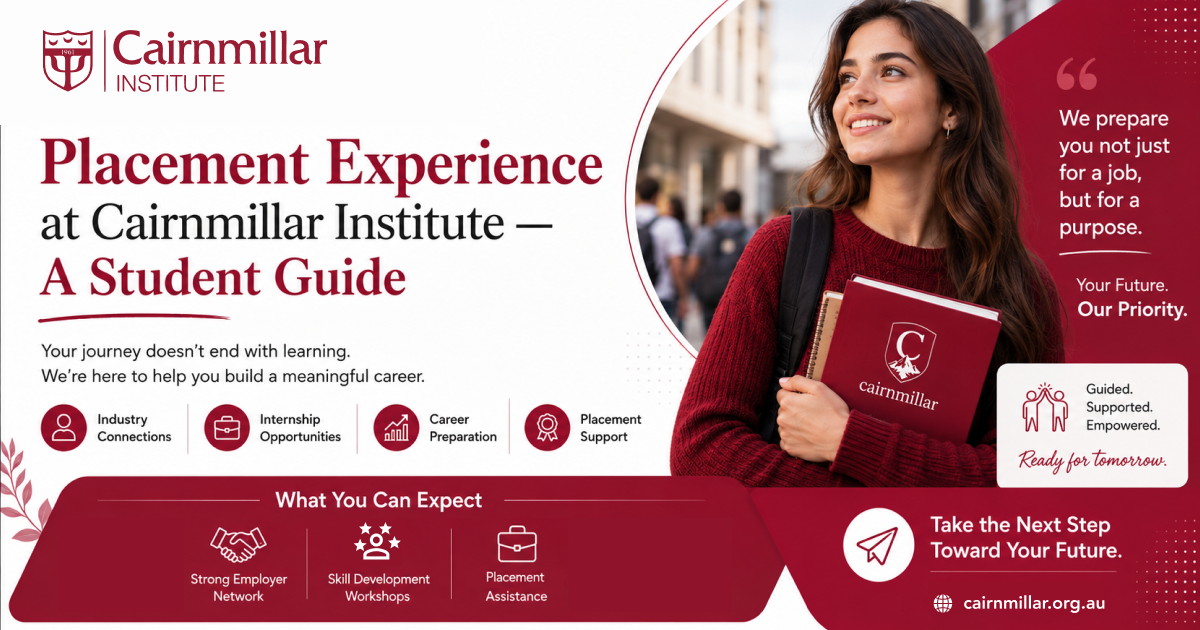
Placements are one of the most significant stages in the training of any psychology, counselling or psychotherapy professional. They are the point where theory becomes practice — where the knowledge built in the classroom is applied in real settings, with real clients, under professional supervision.
At Cairnmillar Institute, placements are an essential component of every relevant course, designed to develop professional competencies and prepare students to enter the mental health workforce as capable, confident practitioners.
According to the Australian Institute of Health and Welfare, around 1 in 5 Australians aged 16 to 85 experienced a mental disorder in the previous 12 months, based on the 2020–2022 National Study of Mental Health and Wellbeing. Placements provide an important opportunity for students to develop practical skills, work with clients under supervision and build experience in professional mental health settings. This guide explains what placements at Cairnmillar involve, how the process works, what you will do on placement, and how the experience prepares you for your career.
Key Takeaways
- Placements are a required component of selected Cairnmillar undergraduate and postgraduate counselling, psychotherapy and professional psychology programs.
- Cairnmillar has over 500 placement partners and facilitates over 400 individual placements every year
- Placements typically involve 2–3 days per week over 4–6 months, with students seeing between 3 and 4 clients per day
- Cairnmillar can arrange supervision for students whose host organisation does not have a registered supervisor on staff
- The placement matching process begins approximately 9 months before the placement start date to find the best fit between student and organisation
What Is a Placement in Psychology and Counselling?
A placement in psychology, counselling or psychotherapy is a structured period of part-time supervised practice in an organisation. Placements are designed to develop the professional competencies that students need to provide high-quality, industry-ready services after graduation.
Placements at Cairnmillar are an integral part of each relevant course — not an optional extra. They are the component of training where students move from understanding therapeutic theory to applying it in practice, with guidance from experienced supervisors who help them reflect on their clinical work and continue to develop their skills.
Which Courses Include Placements at Cairnmillar?
Placements are included in several of Cairnmillar’s professional psychology, counselling and psychotherapy programs. Placement requirements, hours and structures vary depending on the course. The courses that include a placement component are:
Counselling and Psychotherapy:
- Bachelor of Psychology and Counselling
- Graduate Diploma of Counselling and Psychotherapy
- Master of Counselling and Psychotherapy
Psychology:
- Master of Professional Psychology
- Master of Psychology (Clinical Psychology)
- Doctor of Psychology (Clinical Psychology)
- Master of Clinical Psychology (Post-Registration)
What Does a Placement Involve?
Placements at Cairnmillar typically involve the student working approximately 2 to 3 days per week for a period of 4 to 6 months, during which they see between 3 and 4 clients per day. For some programs — particularly psychology internships — placements last for 12 months or more.
During a placement, you will provide direct client services under the supervision of a registered or accredited supervisor. The type of work you do will depend on the organisation you are placed with and the course you are completing — but across all programs, placement involves direct client contact, structured supervision, and ongoing professional development.
The organisations that host Cairnmillar placement students span a wide range of mental health and community settings. Cairnmillar has over 500 placement partners across Australia, facilitating over 400 individual placements every year.
What Skills Do You Develop on Placement?
Placement is where the professional skills developed during coursework become embedded through practice. Depending on the course and placement setting, students may develop skills in areas such as direct client engagement, intake, assessment, case formulation, therapeutic intervention, professional communication and documentation, ethical decision-making, reflective practice and the effective use of supervision, and the ability to work within an organisational setting alongside other health and community professionals.
The breadth of placement partner organisations can expose students to different client groups, service models and professional environments, depending on their course and placement arrangements.
How Does the Placement Matching Process Work?
Cairnmillar’s placement team generally begins arranging placements around six to nine months before the placement start date, with planning commencing approximately nine months in advance in some cases. This lead time reflects the care taken to coordinate the best possible match between students and organisations. This work is supported by staff involved in teaching and placement coordination, including roles such as Lecturer / Placement Coordinator.
The placement process involves the following steps. First, the placement team assesses each student’s learning and development needs. Second, the team liaises with current and new placement partners to assess each organisation’s needs, offerings and suitability. Third, the team assesses the goodness of fit between organisations and students and coordinates placement applications.
Supervision During Placement
All placements at Cairnmillar involve structured supervision. Supervision is a core professional requirement for students in psychology, counselling and psychotherapy training — it is the mechanism through which students reflect on their clinical work, identify areas for development and continue to build professional competence.
Cairnmillar’s approach to supervision is also supported by its Clinic Supervision Policy, which outlines the framework and expectations for supervision within its clinical services and training environment.
If a host organisation does not have a registered supervising psychologist or counselling supervisor on staff, Cairnmillar can arrange supervision for all students undertaking placement. Cairnmillar also offers in-kind supervision and Board Approved Supervisor training for placement partners — supporting the professional development of supervisors within partner organisations. Details of supervisor training programs are available on the Professional Development page.
The Career Benefits of Completing a Placement
Placements at Cairnmillar are designed to help students develop professional competencies alongside their academic learning. The direct client contact, structured supervision and professional development that placements involve build the practical capability that employers across Australian mental health services look for when recruiting.
Cairnmillar’s placement partners benefit from hosting students who are highly competent, carefully screened for suitability to the agency, hold previous workplace experience, and in many cases hold additional qualifications. This reciprocal arrangement benefits both the student and the organisation — and contributes directly to addressing Australia’s mental health workforce needs.
Cairnmillar-published Graduate Outcomes Survey data for 2021–2023 reports that 94.4% of graduates found employment, 1.6 percentage points above the national comparison reported alongside the result. Source: compared.edu.au/institution/the-cairnmillar-institute/postgraduate.
About Cairnmillar Institute
Cairnmillar Institute has been working in mental health education, research and clinical practice since 1961. As a not-for-profit organisation and registered health promotion charity, one hundred per cent of all tuition fees are directed back into the community — including funding free counselling services for those who cannot afford private care.
The student journey extends beyond classroom learning and supervised placements to important academic milestones, including Cairnmillar’s 2026 Graduation ceremony, which celebrated the achievements of students completing their studies.
Cairnmillar’s Triple Helix Model connects education, research and clinical practice, creating opportunities for evidence, teaching and professional practice to inform one another.
Cairnmillar’s commitment to its people and professional environment has also received external recognition, with the Institute being named among the top 10 AFR BOSS Best Places to Work for 2023.
Cairnmillar operates four clinic locations across Melbourne — Hawthorn East, Melbourne CBD, North Melbourne and Dandenong. Depending on the course and placement arrangements, some students may undertake supervised experience within Cairnmillar services, while others complete placements with external partner organisations.
Conclusion
Placement is one of the most important experiences in the training of any psychology or counselling professional. It is where the knowledge and skills developed during coursework are tested, refined and embedded through direct practice. At Cairnmillar Institute, placement is not an afterthought — it is a carefully coordinated, professionally supervised component of every relevant program, supported by over 500 placement partners and decades of experience in clinical training.
Whether you are considering undergraduate study, a postgraduate counselling program or a doctoral psychology pathway, understanding what placement involves is an important part of choosing the right course and preparing for a meaningful career in the mental health field.
Frequently Asked Questions
Q: Which Cairnmillar courses include a placement component?
Placements are included in the Bachelor of Psychology and Counselling, Graduate Diploma of Counselling and Psychotherapy, Master of Counselling and Psychotherapy, Master of Professional Psychology, Master of Psychology (Clinical Psychology), Doctor of Psychology (Clinical Psychology), and Master of Clinical Psychology (Post-Registration). Visit the Placements page at cairnmillar.org.au for full details.
Q: What does a typical placement at Cairnmillar involve?
Cairnmillar’s general placement guidance states that placements typically involve approximately 2 to 3 days per week over 4 to 6 months, with around 3 to 4 clients per day. Requirements vary significantly by course, and some internship or professional psychology pathways may involve placements lasting 12 months or longer. All placements involve direct client contact under professional supervision. The specific work depends on the host organisation and the course being completed.
Q: How does Cairnmillar match students with placement organisations?
The placement process begins approximately 9 months before the placement start date. Cairnmillar’s placement team assesses each student’s learning needs, liaises with placement partners to assess organisational suitability, coordinates placement applications and matches students to organisations based on the best fit between student background and organisational needs. A placement meeting is then held to discuss expectations for all parties before the placement begins.
Q: What if my placement organisation does not have a supervisor on staff?
If a host organisation does not have a registered supervising psychologist or counselling supervisor, Cairnmillar can arrange supervision for all students undertaking placement. Cairnmillar also offers in-kind supervision and Board Approved Supervisor training for placement partners through its Professional Development programs.
Q: How many placement partners does Cairnmillar have?
Cairnmillar has over 500 placement partners across Australia and facilitates over 400 individual placements every year. Placement partners span a wide range of mental health, community services and health settings — providing diverse clinical experience across different client groups and service models.
Q: Are Cairnmillar’s placement programs accredited?
Accreditation applies to the overall course rather than to the placement component in isolation, and accreditation varies by program. Cairnmillar’s professional psychology programs with placements are accredited by APAC. The Bachelor of Psychology and Counselling and Graduate Diploma of Counselling and Psychotherapy are accredited by the ACA, while the Master of Counselling and Psychotherapy is accredited by both the ACA and PACFA. Prospective students should check the relevant course page for current accreditation details.
Q: How do I find out more about placements at Cairnmillar?
Visit the Placements page at cairnmillar.org.au for full details on placement partners, the placement process and courses that include placements. You can also call 1800 391 393 or book a free one-on-one consultation with the Student Services team via the How to Apply page.