
Human Research Ethics Committee (HREC) procedures
1. Preamble
The Human Research Ethics Committee (HREC) is a standing committee of The Cairnmillar
Institute Council (the Council) and is responsible for the oversight of all matters related to the ethics review of human research conducted through the Institute. The HREC ensures that any human research undertaken by the Institute staff, students or honorary associates is designed and conducted in accordance with the Australian Code for the Responsible Conduct of Research; and is ethically reviewed and monitored in accordance with the National Statement on Ethical Conduct in Human Research (NSECHR).
All research involving humans at the Institute must meet appropriate scholarly or scientific standards. Those conducting research must be suitably trained and qualified in appropriate research methodologies and applications, or, where still in training, are suitably supervised.
2. Procedures
2.1 Values and Principles of Ethical Conduct
Research that involves people, their data and/or bio-specimens will only be undertaken at the Institute where it is ethical and conducted responsibly. All risks involved in human research will be assessed, minimised and managed to ensure that the welfare and interests of the participants, researchers and institutions are adequately protected throughout the research process.
2.1.1 Respect for human beings - requires respect for the privacy, confidentiality and cultural sensitivities of research participants. All people involved in research have the right to make informed decisions about matters that affect them. People must be protected and empowered if their capacity to make informed decisions is impaired.
2.1.2 Research merit and integrity - requires the use of methods, facilities and resources that are appropriate to achieve the aims of the research. Benefits of research must be justified, it should be supervised by researchers with appropriate expertise, and findings reported accurately and responsibly.
2.1.3 Justice - requires procedural fairness in the recruitment of participants and review of research. Research aims should be achieved using 'just' means that do not unfairly burden particular groups. The benefits of research should be distributed fairly between participants and the wider community, and research findings should be provided within a reasonable time.
2.1.4 Beneficence - requires sensitivity to the welfare and interests of participants, and the cultural and social implications of the research. The likely benefits to participants or the wider community must justify any risk of harm or discomfort to research participants.
2.2 Assessment of Risk, Harm, Discomfort, Burden and Inconvenience
2.2.1. Assessment of risks involves identifying risks, gauging their probability and severity, and then assessing ways in which the risks can be minimised, mitigated, and managed. Researchers need to be aware of how their research may lead to harms, discomforts, burdens, and/or inconveniences for participants and/or others.
2.2.2 The National Statement on Ethical Conduct in Human Research identifies the following kinds of potential harms in research, noting that the following list may not be exhaustive:
a) physical harms: including injury, illness, pain or death;b) psychological harms: including feelings of worthlessness, distress, guilt, anger, or fear or anxiety related, for example, to disclosure of sensitive or embarrassing information, re-traumatisation, or learning about genetic susceptibility to an untreatable disease;
c) devaluation of personal work: including being humiliated, manipulated, or in other ways treated disrespectfully or unjustly;
d) cultural harm: including misunderstanding, misrepresenting or misappropriating cultural beliefs, customs or practices
e) social harms: including damage to social networks or relationships with others; discrimination in access to benefits, services, employment or insurance;
f) social stigmatisation; and unauthorised disclosure of personal information;
g) economic harms: including the imposition of direct or indirect costs on participants;
h) legal harms: including discovery and prosecution of criminal conduct.
2.2.3 A risk is a potential for harm or discomfort. It involves: (a) the likelihood that a harm or discomfort will occur; and (b) the severity or magnitude of the harm or discomfort, including their consequences.
2.2.4 Less serious than harm is discomfort, which can involve body and/or mind. Examples include minor side-effects of medication, discomfort related to measuring blood pressure, and anxiety associated with an interview.
2.2.5 Less serious than discomfort is burden and inconvenience. Examples include filling in a form, participating in a street survey, or giving up time to participate in research.
2.2.6 Some participants may face greater risks of harm or discomfort than others within the same study.
2.2.7 In considering the level of risk associated with the proposed research, researchers should consult all relevant sections of the 2025 NSECHR, including Chapter 2.1 which provides examples of risk of harm and discomfort and Section 4 (Ethical Considerations Specific to Participants in Research).
2.3 HREC Guide to Ethical Decision Making
2.3.1 It is acknowledged that each research proposal will be unique and will entail potentially unique ethical issues for consideration.
2.3.2 Issues that the Committee should consider in its deliberations include, but are not limited to:
a) The research credentials of the investigators;
b) The merit and integrity of the research;
c) Respect for persons involved in the research, including the dignity, welfare, rights, beliefs, perceptions, customs, and cultural heritage of participants;
d) The likelihood and level of harm or discomfort to participants;
e) The burden and inconvenience of participation on individual participants or identified groups;
f) Any source of financial, or in-kind support, to researchers and/or participants, in particular where conflicts of interest may arise or be evident;
g) Confidentiality of participants and of all material relating to participants;
h) Security of data during and following completion of the project;
i) Documents, materials and procedures used to inform participants and obtain informed consent;
j) Any necessity for advocates and or interpreters;
k) Appropriate supervision of student researchers in the conduct and reporting of the research.
2.3.3 Determinations of research merit arising from prior robust peer review should, where available, be factored into subsequent scientific and ethics reviews of the research.
2.3.4 In reviewing research proposals involving the following groups and/or contexts, the HREC will apply the general principles of the NSECHR and give particular attention to its requirement that researchers and reviewers consider potential sources of increased risk arising from the characteristics and circumstances of individual participants within the context of the specific research project. In doing so, the HREC recognises that individuals who identify, or who are identified, as members of these groups are not necessarily more vulnerable, and may not in all cases experience the increased risks often attributed to them:
a) People who are pregnant, the human fetus and human fetal tissue
b) children and young people;
c) persons experiencing physical or mental ill-health or disability;
d) persons in dependent or unequal relationships;
e) Aboriginal and Torres Strait Islander Peoples;
f) research involving participants residing in other countries and/or research conducted in other countries.
g) research that may discover illegal activities;
h) research undertaken during natural disasters, public health emergences or other crises.
2.3.5 The HREC will also pay consideration to the general principles and more specific guidance outlined in the NSECHR with proposals that involve:
a) multi centre research;
b) clinical trials;
c) innovative clinical practice, therapy or intervention;
d) epidemiological research;
e) human genetic and genomic research;
f) the use of human tissue samples; or
g) research that involves planned deception of participants, active concealment of information, or covert observation.
2.3.6 In addition to the NSECHR, researchers and HREC reviewers are required to consult relevant documentation that specify applicable ethical guidelines, safety standards and regulatory requirements; e.g., in the context of clinical trials and research involving reproductive technology or ionising radiation.
2.3.7 If the proposed research requires unsupervised access to individuals from a group such that a police check of the researchers and/or Working with Children Check is required, evidence of that police check and/or Working with Children Check must be declared in the research proposal.
3. Determining the Level of Ethical Review of Human Research
3.1 Guidelines for Determining Eligibility for Lower Risk Review
3.1.1 Lower risk research’ is described as research involving: 1. Minimal risk (no risk of harm or discomfort; potential for minor burden or inconvenience); or 2. Low risk (no risk of harm; risk of discomfort; may involve foreseeable burden).
3.1.2 Research involving any of the following should not be reviewed as ‘lower risk research’ and requires review by the full HREC:
a) use of identifiable / coded health information without participant consent (e.g., medical records)
b) data linkage research;
c) any physical / psychological / devaluation of personal worth / social / cultural / economic / legal risks greater than discomfort or inconvenience (short or long term) resulting from participation or use of data in this project;
d) sensitive / contentious issues (e.g., suicide, trauma, violence)
e) interventions and therapies;
f) genomic research, human genetics, human stem cells, and human biospecimens (defined in the NSECHR as ‘any biological material obtained from a person including tissue, blood, urine and sputum; it also includes any derivatives of these’);
g) pregnancy, the human fetus, and human fetal tissue;
h) children and young people;
i) Aboriginal and Torres Strait Islander people and communities;
j) people highly dependent on medical care who may be unable to give consent;
k) people experiencing physical disability or serious physical ill-health;
l) people experiencing mental ill-health;
m) people with a cognitive impairment or an intellectual disability;
n) people who are neurodivergent;
o) people in dependent or unequal relationships;
p) people involved in illegal activities;
q) research where it is foreseeable that researchers may discover illegal activity;
r) research conducted in other countries;
s) research conducted during natural disasters, public health emergencies or other crises.
3.2 Lower Risk Review Subcommittee
3.2.1. Research that meets the NSECHR criteria for classification as ‘lower risk research’ may be submitted to the Lower-Risk Review Subcommittee, which consists of members of HREC with the required experience and awareness of what constitutes ethical research.
3.2.2. All submissions to the Lower-Risk Review Subcommittee will be reviewed by at least two members of the subcommittee. These reviewers may recommend that the research requires full review by the HREC. In such cases, reviewers will notify the HREC Secretary who will table the application for review at the next available HREC meeting and notify the researchers.
3.2.3. Applications to transfer an externally approved project will include:
3.3 Multi-Centre Reserach
The NSECHR states that duplication of ethics review should be avoided. Accordingly, the Institute accepts human ethics approvals from other human research ethics committees registered with NHMRC and processes multi-centre research applications under expedited review procedures (see 3.4.2) where the Institute researchers are involved but the Chief Investigator is from another institution.
The Institute reserves the right to place conditions on or refuse involvement should approved proposals not conform to the requirements of the NSECHR and other relevant legislation or potentially expose the Institute to undue risk.
Where the Chief Investigator is an Institute staff member, primary approval must still be obtained from the Institute HREC. Other institutions are expected to follow the recommendations of the NSECHR and to likewise accept approvals by the Institute HREC.
In multicentre research reviewed by a single HREC, only that reviewing HREC can undertake core monitoring functions, as other participating institutions’ HRECs may not have knowledge of the project. Monitoring responsibilities should align with the scope of the reviewing HREC’s assessment. Clear allocation of roles is essential: sponsors (particularly in clinical trials), institutions, review bodies, and researchers all have defined monitoring and reporting duties that must be explicitly agreed. Institutions may hold multiple roles (e.g., sponsor, coordinating site, ethics review host, or participating site) and should transparently define the monitoring responsibilities associated with each role.
3.3.1 Review under Memorandum of Understanding (MoU)
The responsibility of ethical review of any projects conducted with organisations with which The Cairnmillar Institute has an existing MOU will follow process as indicated in the agreement. Where MOUs are with hospitals, generally the hospital will have full responsibility of ethical review and monitoring of the research. Staff from The Cairnmillar Institute are required to notify HREC of any approved projects and forward a copy of the approval letter and final application for the institute’s records. No additional ethical review of the project will be undertaken.
3.4 Exemptions or Expedited Reviews
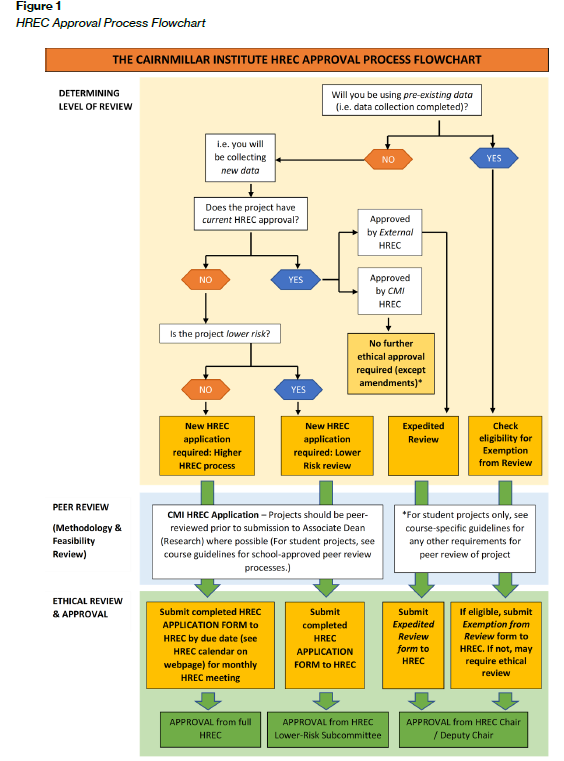
Researchers should refer to the HREC Approval Process Flowchart (see Figure 1), to determine their eligibility for exemption from ethical review or expedited review.
3.4.1 Researchers should consult the NSECHR before applying for an exemption from ethical review. Projects may be eligible for exemption from ethical review if they carry a low risk to participants and the community AND satisfy one or more of the following conditions:
a) the research involves the use of collections of information or data from which all personal identifiers have been removed prior to being received by the researchers; and researchers agree not to attempt to re-identify individuals, to take reasonable steps to prevent unauthorised re-identification or data access, and to ensure any data sharing does not increase re-identification risk;
b) the research is restricted to surveys and observation of public behaviour using information that was or will be collected and recorded without personal identifiers and is highly unlikely to cause distress to anyone associated with the information or the outcomes of the research;
c) the research is conducted as part of an educational training program in which the research activity is for training purposes only and where any outcomes or documentation are for program use only; or
d) the research uses only information that is publicly available through a mechanism set out by legislation or regulation and that is protected by law.
Applications for exemptions from ethical review will be assessed by one or more members of the HREC Executive, depending on level of complexity or risk. The HREC Secretary will notify researchers of the outcome of their application.
Teaching activities and quality assurance activities are not required to make a formal exemption request, but researchers can do so if they want to create a record of their decision.
3.4.2 Expedited Review
Projects may be eligible for expedited review if they have received approval from an external HREC (refer to Section 3.3 of these guidelines and procedures). Researchers are required to complete the Expedited Review form and submit to HREC Secretary, with a copy of the approval letter from the external HREC and the final application form approved by the external HREC.
Applications under this category will be assessed by one or more members of the HREC Executive, depending on level of complexity or risk, who must be satisfied that the research proposal has been reviewed appropriately according to the National Statement. Unless the level of review is deemed inappropriate, HREC will issue an approval based on the external HREC’s review.
Note: Research that involves using personal information without consent cannot be exempt from ethics review - undertaking such research would require a waiver of the consent from the full HREC.
4. Compliance and Reporting Procedures
4.1 Compliance with Regulations
4.1.1. Researchers are required to comply with conditions advised by the HREC. In turn, the HREC, or the Institute, will provide information from its records as required by the NSECHR to the NHMRC or other mandated authority, provided at all times that the rights and welfare of researchers and participants is respected.
4.1.2. The HREC will maintain a register/database of applications and record the outcome of each application, along with information required for NHMRC annual reporting requirements (see 4.2.2).
4.1 HREC Reporting Obligations
4.2.1. The HREC must report regularly to the Academic Board (the Board), including minutes of HREC meetings (to be forwarded within three weeks after a meeting) and annual reporting to be completed by 31 March covering the previous calendar year. The annual report must include:
a) Number of projects assessed and approved or rejected;
b) numbers of complaints received and how they were dealt with;
c) activities that have supported the educational needs of HREC members;
d) procedural changes;
e) administrative or other difficulties being experienced; and
f) any matters that may affect the Institute’s ability to maintain compliance with the NSECHR and if necessary, the provision of suitable recommendations.
4.2.2. The HREC will report annually to the NHMRC, or other mandated party, information relevant to its procedures that is requested by the NHMRC or that party, in accordance with the NSECHR or its equivalent at the time.
4.2.3. The HREC will provide a publicly accessible annual report on the Cairnmillar website to meet NSECHR / NHMRC reporting requirements for transparency; e.g., summary descriptions of all research projects for which the requirement for consent has been waived (with some limitations regarding projects that involve exposing illegal behaviours, as per the NSECHR 2.3.12).
5. Procedures for Review of Research Protocols
5.1 Applying for HREC Approval
5.1.1. Researchers will submit the completed application form, including specifying whether the research is lower risk or higher risk, and attach copies of any supplementary documentation. The form must be complete with Associate Dean (Research) or nominee signature before submitting to HREC Secretary. The HREC Secretary will issue the researchers with notification of receipt followed by notification of outcome from the HREC once the application has been reviewed.
5.1.2. Researchers must not commence collection of any human data for their proposed project until HREC approval has been obtained. All approvals are granted subject to conditions specified on the approval letter from HREC.
5.2 Higher Risk Applications
5.2.1. Projects determined to be greater than lower risk research proposals or other research requiring full review by the HREC, excluding proposals considered under the Multi-Centre processes (see 3.3) should be submitted to the HREC Secretary using the current HREC Application Form. Applications must be complete with necessary signatures and supporting documents attached (e.g., recruitment advertisements, questionnaires, interview schedules, Plain Language Information Statement, Consent Form, evidence of approval from external agencies related to the research, evidence of approval from other HRECs).
5.2.2. Completed proposals will be receipted, assigned a project number, and entered into the register/database by the HREC Secretary, and then assigned to the next available HREC meeting.
5.2.3. Meeting dates for HREC and due dates for higher risk application submissions and other agenda items are published online (e.g., myCMI). Attendance at HREC meetings by researchers or other observers is strictly by invitation.
5.2.4. Researchers will be notified via email of the review outcome for their project within 10 days of the HREC meeting at which the proposed project is considered. If there are no issues to be addressed, researchers will receive an approval letter. Any issues that are to be addressed by researchers will be outlined in the feedback form provided by HREC. Applications which have issues to be addressed will only be approved subject to researchers addressing these issues to the satisfaction of the HREC Chair, nominee or committee.
5.3 Lower Risk Applications
5.3.1. Projects considered ‘lower risk’ (refer to Section 3) can be submitted at any time to the HREC Secretary, using the HREC Application Form. Applications must be complete with necessary signatures and supporting documents attached (e.g. recruitment advertisements, questionnaires, interview schedules, Plain Language Information Statement, Consent Form, evidence of approval from external agencies related to the research, evidence of approval from other HRECs).
5.3.2. Completed applications will be receipted by the HREC Secretary and entered into the register/database. The HREC Secretary will then assign the application to two members of the Lower Risk Review Subcommittee, excluding any members who are listed as researchers on the application. On rare occasions the HREC may determine that compliance with the requirements of the National Statement cannot be achieved through revisions to an application. Where this is the case, the applicant will be notified that the application will not be approved.
5.3.3. Reviewers may recommend that the research requires full review by the HREC. In such cases, reviewers will notify the HREC Secretary who will table the application for review at the next available HREC meeting and notify the researchers.
5.3.4. With the exception of lower risk applications that are subsequently assessed as higher risk (see 5.3.3), researchers who submit lower risk applications will be notified via email of the review outcome within 3-4 weeks from submission of their application. Issues that are to be addressed by researchers will be outlined in a reviewer feedback form which will be forwarded to the researchers by the HREC Secretary.
5.3.5. Applications that have issues to be addressed will be approved subject to researchers addressing these issues to the satisfaction of the HREC Chair or delegate. For an outline of possible decision outcomes refer to section 5.4.
5.3.6. Researchers cannot commence collection of any human data for their proposed project until HREC approval has been obtained. All approvals are granted subject to conditions specified on the approval letter from HREC.
5.4 Possible Outcomes
Once research teams have implemented feedback provided by reviewers and returned their revised application documents, they will receive a notification with one of the following outcomes.
5.4.1 Approved
a) Your application has been approved, and no further action is required.
b) You are free to commence your project on the commencement date outlined in the official approval to commence research letter.
5.4.2 Approved with Conditions
a) Your application has been approved but there may be small oversights in the application, or minor updates/changes required prior to official commencement.
b) You will need to attend to the issues specified and return your updated application documents, where required. The application will not need re-review by the full HREC or by the Lower Risk Review Subcommittee.
c) You are free to commence your project on the commencement date outlined in the official approval to commence research letter unless advised otherwise.
5.4.3 Resubmission Required (Higher Risk applications)
a) Your application has not yet been approved; the committee has some concerns.
b) You need to address the concerns raised and resubmit your application for consideration by HREC.
c) Your resubmitted application should address the issues outlined in the notification, with all revisions clearly shown by using highlighted text.
d) Researchers need to submit a cover letter which clearly states how each of the issues raised by the HREC have or will be addressed.
e) The resubmitted application will be re-reviewed by HREC.
f) Following this review, you will be issued with a new Notification of Outcome.
5.4.4 Not Approved
a) Your application has not been approved, and the committee has serious concerns regarding the overall research (besides ethical concerns, this may also include legal or reputational risks to the Cairnmillar Institute).
b) You will need to decide on a different project and submit a new application for consideration.
c) Submit the new application together with any necessary documentation to the HREC Secretary for consideration at an HREC meeting.
d) Following this consideration, you will be issued with a new Notification of Outcome.
5.5 Appealing Against Outcomes
5.5.1. If researchers wish to appeal against any decision made by HREC committees about their research project or express concerns about the ethics administration process, they should initially approach the Faculty Dean, who in turn will inform the HREC Chair of the nature of the complaint. Consultation will take place between the Chair and the Dean, and if the researcher is not satisfied with the result the matter will be referred to the Chair of the Academic Board.
5.6 Withdrawal of HREC Approval
5.6.1. HREC approval is limited strictly to the research proposal as submitted in an application.
5.6.2. If the HREC Chair believes that the research project is not compliant or cannot comply with the protocol as it was approved, the HREC may withdraw approval. In such cases, the HREC will inform researchers of the withdrawal of the approval and recommend to the Institute that the research project be discontinued, suspended, or other steps be taken.
5.6.3. A researcher must not continue with a project if ethical approval has been withdrawn and must comply with any special conditions required by the HREC.
5.7 Reporting to HREC After Approval
The HREC is responsible for monitoring approved research to establish that the ethical standards of research are being maintained. As part of this monitoring process, the HREC requires as a condition of approval that the Principal Researcher keeps the HREC informed of the project’s progress, its status (completed, discontinued), any variations to the research protocol, and any serious or unexpected adverse effects.
Researchers should note that these reporting requirements are a condition of HREC approval and any failure to report may result in approval being suspended or withdrawn.
5.7.1 Reporting Process
a) If the project has a duration of longer than 12 months, the researchers must submit annual reports. The first annual report is due 12 months from the date of initial approval.
b) Upon approval of the project, researchers will be informed of the dates on which they are required to submit reports. These can be found on the approval notification form.
5.7.2. Reporting completion or discontinuation
a) To report completion of a project, researchers should complete an HREC Final Report form and submit this to the HREC Secretary. A research project will be considered complete when all of the following criteria have been met:
i Cessation of Participant Involvement: All data collection and direct contact with participants have concluded, including any follow-up required by the protocol.
ii Resolution of Participant Safety and Wellbeing Obligations: There are no ongoing risks or active monitoring requirements in relation to participant safety or wellbeing that require reporting to the HREC (e.g., serious adverse events).
iii Completion of Data Acquisition: Data relevant to the primary aims of the project have been collected and analysed, with no further data acquisition planned. (Closure of the study does not mean that the data cannot be further analysed by people with authorised access to the data).
iv Research Output and Communication: A plain language summary of findings from the primary analyses has been prepared for dissemination (e.g., publication on the Cairnmillar website).
b) If a decision is made to discontinue a project after it has been given HREC approval, researchers must inform the HREC by completing a Final Report form and provide reasons for the decision. Once advised, the HREC will assess whether any participant has been or will be disadvantaged because of the project’s discontinuation.
5.7.3 Reporting adverse or unforeseen effects and events
a) Researchers must report immediately to the HREC anything that might warrant review of the ethical approval of the protocol, including serious or unexpected adverse events that might affect continued ethical acceptability of the project. Failure to do so may result in discontinuation of approval and/or disciplinary action.
b) The Principal Researcher is responsible for reporting any issue or occurrence that may warrant review of the ethical approval of the project, including serious adverse events, and any problems relating to the conduct of the project.
c) The report should detail the events, outline their significance, describe how they relate to the research, and whether any amendments to the research protocol will be required. The report should also detail any steps that have already been taken or are proposed to be taken to address the adverse effects/events being reported. These details should also be included in any Annual / Final Report.
5.7.4 Audit
In line with the NSECHR, human research projects may be subject to audit by the HREC. As part of the audit process, an HREC may invite researcher(s) to be present for discussions of the research and may request amendments to the research protocol. The emphasis of the audit process will be on research that presents higher than normal risk for participants.
5.8 Amendment Requests
5.8.1. Requesting approval for proposed amendments
a) A formal request must be submitted to the HREC for consideration and approval of any amendments or modifications researcher/s wish to make to an HREC-approved project. If the HREC determines that the proposed changes are significant, researchers may be required to submit a new application.
b) To request project amendments, researchers should complete a Request for Amendments to Existing Project form and submit this to HREC as soon as possible.
5.8.2. Requesting an extension to the project completion date
HREC approval is granted until the completion date specified in the approval letter. If a project is expected to continue beyond this date, the researcher must submit a Request for Amendments to Existing Project form to the HREC as soon as the need for an extension is identified. Projects may be renewed where there is appropriate justification for the continuation of the research. While extensions are typically granted for one year, longer extensions of up to three years may be approved where sufficient justification is provided. In considering requests for extension, the HREC will take into account the nature, progress, and anticipated duration of the project. This approach is intended to reduce unnecessary administrative burden for both researchers and the HREC while ensuring appropriate oversight of ongoing research. Where a project is to continue beyond the maximum approved extension period, submission of a new ethics application may be required.
6. Privacy
When collecting personal information, researchers should consider privacy and confidentiality. This includes who will (and who will not) have access to information collected during the project; the adequacy of proposed storage and security measures; the measures proposed to protect confidentiality; and the manner and form in which results will be published, and whether these adequately protect the confidentiality of information and privacy of participants.
6.1 Responsibilities of Researchers
Although the HREC considers the privacy implications of each proposal as part of the review process, researchers are expected to be aware of information privacy principles and how they may apply to the collection, use and disclosure of any personal, health or sensitive information about research participants involved in any part of their research project.
Researchers should also be aware that the NSECHR recognises that the identifiability of information exists on a continuum rather than within fixed categories. The degree to which information can identify an individual depends on contextual and technical factors, including the nature and quantity of information held, who has access to it, opportunities for data linkage, and developments in technology.
Researchers and ethics reviewers should assess the risk of identification and the potential harms arising from identification throughout the lifecycle of a research project. Information may be directly identifiable through specific identifiers such as a name, image, date of birth or address, or may become identifiable through combinations of data or linkage with other datasets. De-identification and re-identification are understood as processes that may alter the degree of identifiability of information over time. Stronger privacy protections are required where information can reasonably be used to identify individuals.
7. Complaints
3.2 Sub Heading
7.1.1. All complaints about human research conducted by staff, students or associates as part of research conducted at The Cairnmillar Institute or approved by the institute’s HREC should be initially sent to the HREC Secretary who will notify the Associate Dean (Research). The Associate Dean (Research) may seek to resolve the matter or forward to the HREC Chair or other members of the HREC Executive for consultation.
7.1.2. For matters forwarded to HREC, the HREC Chair and/or HREC Executive will act on behalf of the committee to fully investigate the complaint. The investigation will be conducted in reference to the relevant policy documents and privacy legislation.
7.1.3. The outcome of the investigation will be communicated to the complainant and the researchers.
8. Management of Human Research Data
8.1 Institutional Responsibilities
8.1.1. The Institute must ensure that research data and records created by students, staff and honorary staff are:
• Stored, secured, and disposed of in accordance with the requirements of the Records and Privacy Act 2002, the Australian Code for the Responsible Conduct of Research 2018 (including relevant topic-specific guides that accompany this Code), and the NSECHR
• Accurate, complete, authentic and reliable
• Retrievable and available when needed
• Compliant with legal obligations and the rules of funding bodies
8.1.2. In addition, the Institute must:
• Retain research data and records for a minimum of five years after publication or public release of the work of research. Longer retention periods may apply to some categories of health information data
• Establish and implement processes for the storage and retention of research data and records
• Secure and/or provide suitable physical and electronic (or virtual) storage space for research data and records
8.2 Researcher Responsibilities
• Appropriate processes are developed for the collection, storage, use, re-use, access and retention of research data and records associated with their research program, including confidential research data and records, and that the information is incorporated into the research data management plan.
• Integrity and security of the research data and records is maintained, and that this material is stored in a retrievable way
• Researchers are aware of confidentiality restrictions, any relevant agreements that impact access to or disclosure of information and report any breach of confidentiality to the Associate Dean (Research) and Faculty Dean.
• Planning for the ongoing custodial responsibilities for the research data and records at the conclusion of the research project or on departure from the Institute, including information about access and potential re-use of the data
• Researchers must establish and document clear procedures for the collection, ownership and storage of research data and records when involved in a joint research project
• When a research project is undertaken under contractual agreement, the principal investigator has overall responsibility for the management of data and records
• In the case of multi-institutional projects, the institution of the principal investigator is ultimately responsible
• Research students must be jointly responsible with their supervisor, for the collection, storage, security and use of research data and records, including confidential research data and records. In addition, research students must deposit research data and records associated with their thesis to the Institute’s research data repository immediately following thesis submission. Students must also provide their supervisor with full details of the location of research data and records
9. Resources and References
• 2018 Australian Code for the Responsible Conduct of Research
• 2025 National Statement on Ethical Conduct in Human Research
• HREC Application Form
• Application for Exemption from Ethical Review
• Application for Expedited Review
• Annual / Final Report Form
• Request for Amendments to Existing Project Form
• Research Hub Canvas site for staff
• myCMI for students and staff